
Gas Chromatography-tandem Mass Spectrometry (GC-MS/MS)
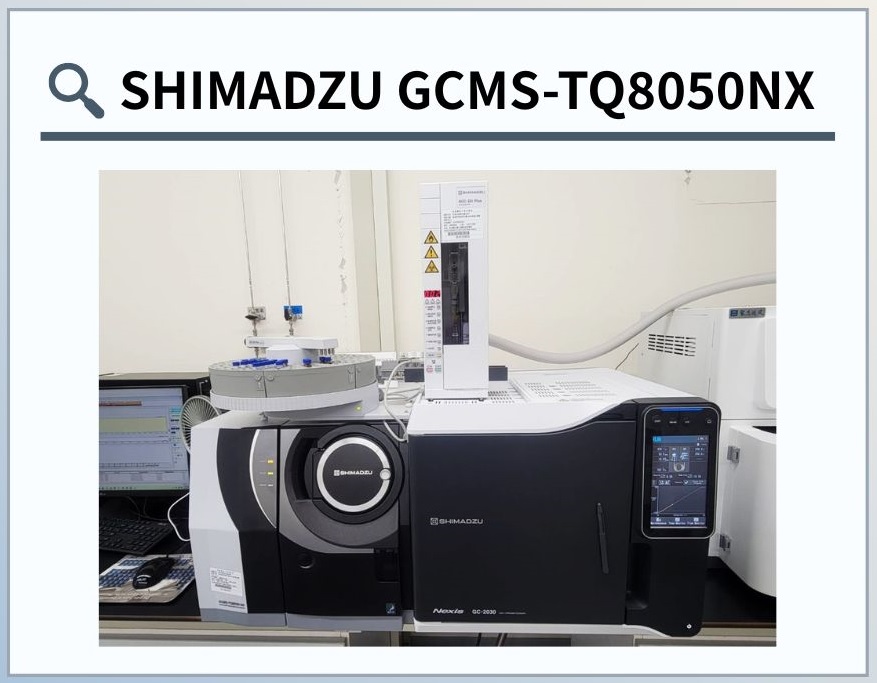
The principle of gas chromatography-tandem mass spectrometry (GC-MS/MS) involves injecting a complex mixture into the instrument, where the sample is vaporized at high temperature and carried by an inert gas—such as helium—into a chromatographic column. Inside the column, individual analytes are separated based on their chemical properties. Upon elusion, the gaseous analytes are directed into the ion source of the mass spectrometer, where they undergo electron impact ionization to form molecular ions and characteristic fragment ions. These ions are subsequently accelerated and directed into the mass analyzer, where they are separated according to their mass-to-charge (m/z) ratios, allowing for both qualitative and quantitative analysis.
GC-MS/MS is primarily employed for the identification and quantification of target compounds in complex matrices. The data acquisition can be performed in various modes, including full scan, product ion scan, selected ion monitoring (SIM), and multiple reaction monitoring (MRM). Its applications include the analysis of carcinogenic compounds in environmental samples, quantification of drug metabolites, detection of pesticide residues in food, monitoring of veterinary drugs, and trace-level analysis in diverse research fields.
【Contract Information】
Dr. Yu-Ming Hsu, Research Fellow
Tel: 07-3121101 ext. 2318
E-mail: maiz538272@gmail.com
|
|
Test Category |
Item for Analysis |
Pricing |
|
1 |
Qualitative analysis of volatile organic compounds (VOCs) |
Butanal、2-Butanone、Benzene、Pentanal、Octane、Hexanal、Valeric acid、3-Heptanone、Styrene、Cyclohexane、Heptanal、Phenol、Hexanoic acid、Decane、Octanal、2-Ethyl-1-hexanol、p-Cresol、Undecane、Nonanal、4-Ethylphenol、Dodecane |
|
|
2 |
Customized analytical method development |
|
To be discussed depending on the type of analyte and sample |
