
【Research Highlights】Understanding Adolescent Metabolic Health with a Single Score: Development and Validation of a Metabolic Syndrome Risk Score (Professor Chien-Hung Lee)
2025 / 10 Professor Chien-Hung Lee (Department of Public Health)
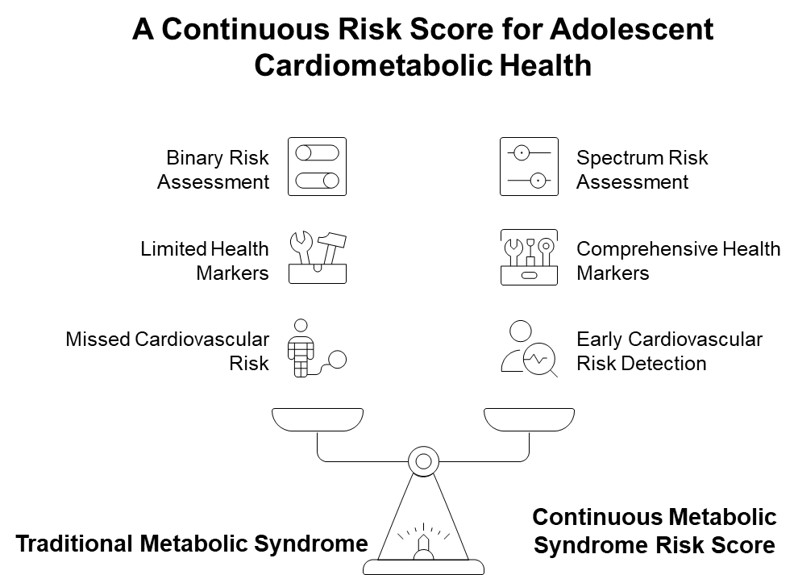
The aim of this study was to transform the binary classification of whether adolescents have metabolic syndrome into a continuous risk score that reflects the degree of metabolic risk. The research team first developed this scoring system using data from 1,920 nationally representative Taiwanese adolescents, and then validated its applicability using data from 3,295 adolescents in southern Taiwan. The risk score was calculated based on five metabolic syndrome components: waist circumference, high-density lipoprotein cholesterol (HDL-C), triglycerides, fasting glucose, and mean arterial pressure (representing blood pressure). To allow qualified comparisons across different ages and sexes, the researchers also developed a system for calculating scores stratified by sex and age. The results showed that the scoring system effectively identified metabolic syndrome in both adolescent populations with high accuracy. More importantly, compared with the traditional binary classification of metabolic syndrome, this continuous score more precisely reflected differences in metabolic health indicators such as body fat percentage, lipid profiles, and insulin resistance, meaning it better represents the degree of metabolic risk. Additionally, individuals with higher scores were more likely to exhibit multiple adverse cardiovascular-related indicators, such as elevated low-density lipoprotein cholesterol, high uric acid levels, and increased insulin resistance, and the risk of presenting three or more cardiovascular clinical markers simultaneously was significantly higher. Overall, this sex- and age-adjusted metabolic risk scoring system has the potential to serve as a better tool for assessing and managing cardiometabolic health in adolescents.
Application and Highlights:
- Metabolic syndrome in adolescents is not merely an accumulation of independent abnormal findings, but is driven by a common underlying “metabolic risk core.” This study applied confirmatory factor analysis to extract the shared latent factor underlying the components of metabolic syndrome, and developed it into a continuous “metabolic risk score.” Additionally, the study further stratified the score by sex and age to enhance comparability and interpretability across different subgroups.
- Compared with the binary classification of “presence/absence of metabolic syndrome,” a continuous risk score can more precisely discriminate risk levels and more sensitively reflect differences in cardiovascular risk among adolescents, thereby facilitating early identification of high-risk groups and promoting preventive interventions.
More Information:
Chin YT, Wu PW, Huang PR, Tsai S, Lin WT, Lee CY, Tsai WC, Lee CH*. Confirmatory-factor-analysis-derived metabolic syndrome risk score: development, validation, and clinical utility in dual adolescent populations. Pediatric Research. 2025 Sep 20.(SCIE, IF2024: 3.1, 26/191=13.61% in PEDIATRICS)
Team Member:
Yu-Ting Chin, Pei-Wen Wu, Pin-Rui Huang, Sharon Tsai, Wei-Ting Lin, Chun-Ying Lee, Wei-Chung Tsai, Chien-Hung Lee
Introduction of Research Team:
The research team has long focused on cardiometabolic health issues among adolescents in southern Taiwan. The team includes epidemiology PhD researchers and postdoctoral fellows with expertise in study design and data analysis, as well as cardiology and family medicine physicians who provide clinical expertise and integrated health care experience.
